The Umbrella newsletter: November 2025
Water harvesters and other fellow collaborators with life,
I was recently on a two-week work and research trip to New Mexico, and want to share with you a number of the inspiring people and their work I was documenting, plus planting guides, water-harvesting gift ideas, rain-irrigated neighborhood native food forestry resources, and more. But first I want to tell you about my new and improved YouTube Channel:

My YouTube channel
is a sweet way for you to meet the inspiring folks in New Mexico, and tour and learn from some of their great work.
Four months ago, I began collaborating with David Fenster and posting a new video to my channel about every two weeks or so. I just put up my ninth video and plan to keep them coming with your help and support. The videos:
- highlight dynamic projects and practitioners
- show you how to design, build, steward, and evolve integrated water-harvesting systems; native rain-irrigated food forestry; and sun & shade harvesting
- capture my lectures and presentations
- and more…
WATCH MY YOUTUBE CHANNEL
These latest videos take a LOT of work, time, and money to produce.
So, to keep them coming, I need your support by:
• SUBSCRIBING to my channel (if you haven’t already)
The more subscribers my channel has, the more YouTube puts my videos in front of new viewers, and you don’t miss my new videos.
• LIKE and COMMENT on the videos you are into.
The more LIKES and comments a video has, the more YouTube puts it in front of new viewers.
• HYPE the videos you are into in the first 7 days after they’ve been released.
HYPING gives videos an extra big boost in YouTube’s algorithm.
Here is how you HYPE a video viewed on an iphone or ipad.
Here is how you HYPE a video viewed on an Android device.
You cannot currently HYPE when viewing video on a computer or TV.
• SHARE my videos with friends, family, local policy makers, on your social media.
Nothing beats a recommendation from someone you know.
• DONATE via my website or give a video a SUPER THANKS when viewed on a computer

If you want to donate to a video via the YouTube platform, click on the three dots below the video (below green arrow above), scroll down, and click on “Thanks”, and a window (below) will pop up allowing you to select your amount, donate, and post a highlighted comment.

New Mexico trip
I recently gave a presentation in Santa Fe for the HomeWise Livibility Speaker Series on how we can improve the quality of life of our homes and communities while making them more affordable.
You can watch the presentation here.
I used the opportunity to meet and visit with a number of city/county officials, non-profits, individual activists, and companies doing great work up there both within the watershed of, and in, the Santa Fe River.
Revival of the Santa Fe River
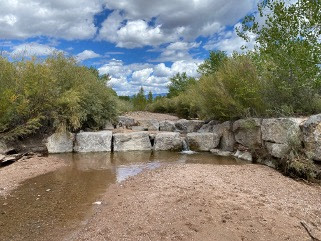
The Santa Fe River and its watershed had long been abused turning it into a dry, eroded, trash ridden, treeless, and inaccessible channel in a number of its reaches, but it now flows again, the erosion has been checked, trash is picked up, and shading native willows and cottonwoods are once again abundant along its banks and many well-used pedestrian and bicycle paths.
Key to this transformation is the community making the river a community focal point once again, rather than turning its back on it.
It was filled with friendly eyes when I visited as there was a non-stop stream of walkers, runners, cyclists, and skaters flowing through the numerous river-side and in-river paths.
Grade-control structures have stabilized the once-downcutting riverbed and induced more of a meander into its once artificially straightened channel. That meander also controls erosion by lessening the steepness of the channel and the speed of its water flow, thereby allowing sediment to deposit rather than wash away, and more stabilizing vegetation to grow in that sediment.
Additionally, Santa Fe used to divert the river’s flow for municipal use via a series of upstream dams and reservoirs, but a percentage of that flow is now allocated to keep downstream stretches of the river flowing.

Image courtesy of the Santa Fe Watershed Association.
Productive collaboration of Santa Fe water-harvesting practitioners
I’ve always been inspired by the Santa Fe water-harvesting community doing restoration both within the Santa Fe River and its tributaries and uplands because they have a number of high-quality practitioners such as The Rain Catcher, Inc., Watershed Artisans, Bill Zeedyk, San Isidro Permaculture, Southwest Urban Hydrology, River Source, Ecotone, and Keystone Restoration Ecology that all do their own thing through their own own companies or non-profits, but if one of them takes on a bigger job, they join forces for that project (with one being the main contractor, and the others being subcontractors). Then they disperse afterwards. That way, no one company or organization has to hold a huge amount of overhead. It’s a supportive community that’s been really effective, and it’s a powerful model that we can duplicate elsewhere.
Everyone is also continuing to innovate and evolve their work, and the cross-pollenization that occurs through collaboration, touring each-others’ work, and inquisitively questioning/challenging each other is essential to spark and grow that evolution.
I have several videos that highlight these people and their work coming out, but one project that I didn’t film was a Watershed Artisans project led by Craig Sponholtz project on the San Antonio Creek out in the wilderness west of Tres Piedras. Craig wasn’t yet ready to document the in-process project but I can describe what I Ioved about it…
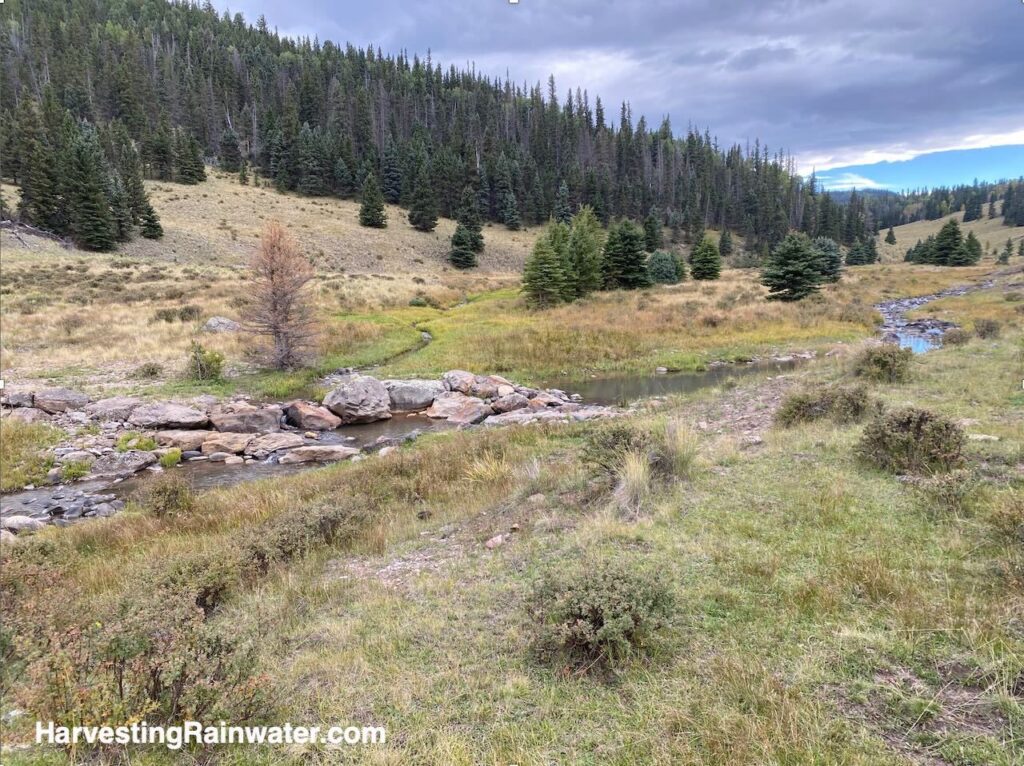
The creek in this alpine valley at first appears incised, maybe down cut creating a single narrow channel in a deep otherwise dry cobble bed, where you’d expect to find a wide expanse of productive wetlands from one side of the valley to the other. But Craig did ample research and found there had been a massive fire followed by massive erosion and flooding in the early 1900s that dumped the thick cobble bed within the valley.
So, the current channel was not incised, instead the water flow was too week to widen or spread out the flow within the thick cobble. Thus, Craig and his crew are creating new, smaller, braiding, sub channels to the sides of the main channel that can spread more of the creek flow throughout the entire width of the alpine valley (especially during flood events) as was likely the case before the massive fire and flood. As a result, the flow and wetlands are again spreading, more groundwater is being recharged and cooled, and fish populations are growing. A number of other strategies are also being used such as beaver dam analogs, induced meandering, stepped pools, etc. But it is not the strategies I love, but rather the care, quality, and beauty of these nature-inspired, natural form installations and how they are consciously woven together to create a truly dynamic integrated system lifting the carrying capacity of the creek and surrounding land just by subtly nudging the cobble, logs, and boulders already there to create healthier and more productive flows.
Craig is restoring himself just as much as the watershed. He is most present in a natural waterway/watershed, and he is trying to figure out how to bring that presence, that more whole way of being, into the rest of this life.
His work is about being in conscious relationship with place. He is here now in this environment, and continually asks himself how can he best contribute to it? Collaborate with it?
Bill Zeedyk – the water whisperer
Bill, a longtime mentor of mine and many of the other Santa Fe water-harvesting practioners, is now 90 years old and continues to inspire and teach others in how to let the water do the work in restoring our upland waterways.
I spent a day with Bill checking out the alluvial fan restoration work he has done on the Fort Union Ranch north of Las Vegas, New Mexico. Alluvial fans are naturally one of the most productive and hydrated landforms, but can be quickly degraded with unconscious roads, paths, and cattle trails that erode and drain the fan.
100+ year old severe gullies caused by wagon wheels going up the alluvial fans in the era of the Fort, severely drained and eroded the fans, but are now being restored by Bill’s “plug and spread” and other strategies.
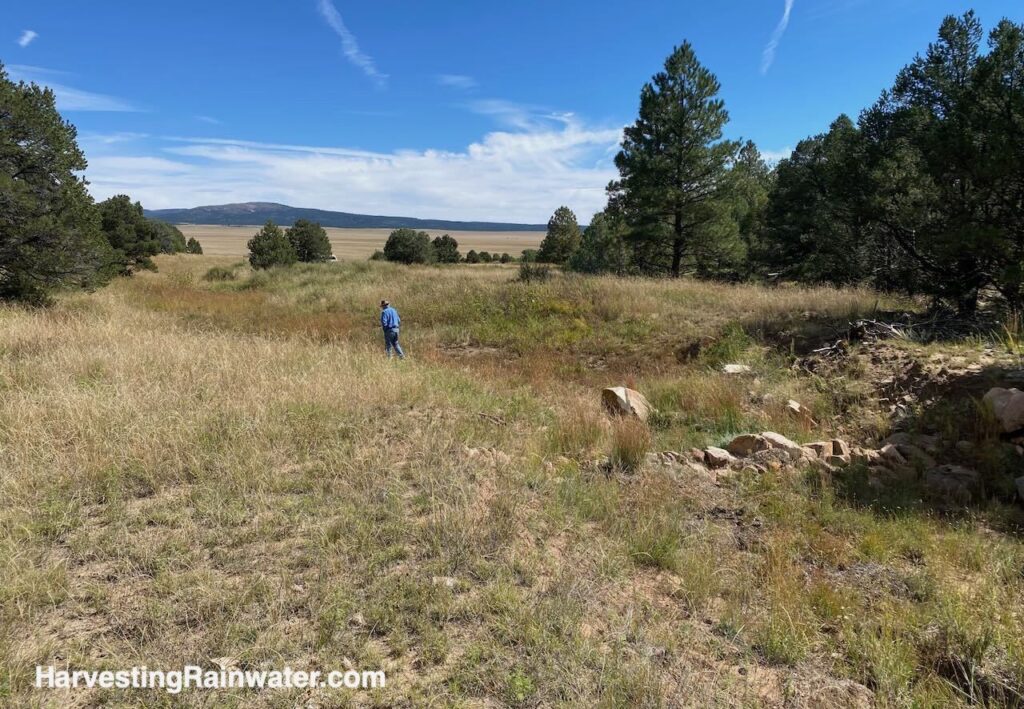
The gully was was formed by a horse and wagon trail going up the dry edge of the fan from Fort Union when soldiers went hunting for upstream firewood and lumber. But when the trail crossed the water flow the wheel ruts captured the once gradual, meandering, shallow flow, within the straighter, steeper, unvegetated and unstabilized dirt road/wagon trail; the water flow sped up, became erosive, and downcut the dehydrating gully.
You can see a video on some of this work here.
And download the free guide “The Plug and Spread Treatment: Achieving Erosion Control, Soil Health and Biological Diversity” from the QuiviraCoalition.org Resources page at this link
Watch the 5-part documentary Thinking Like Water on his work and that of many he has inspired and taught.
Volunteer with the Albuquerque Wildlife Federation to get hands-on experience implementing many of Bill’s restoration strategies.
Read Bill’s book “Let the Water Do the Work: Induced Meandering, and Evolving Method for Restoring Incised Channels”
Read chapter 10: In-Channel Strategies of the full color edition of my book “Rainwater Harvesting for Drylands and Beyond, Volume 2: water-harvesting earthworks” on which I collaborated with Bill Zeedyk.
Other New Mexico-based resources well worth checking out
Regenesis Group
AmpersandProject.org – Madrid, NM
Stream Dynamics – Silver City, NM
Inspire and inform others with water-harvesting gifts
these holidays with the new, revised and expanded, full-color my books Rainwater Harvesting for Drylands and Beyond available at deep discount direct from me at my webstore, plus Plant the Rain shirts, caps, and stickers in English and Spanish – which make great stocking stuffers.
Self-guided water-harvesting tours
Many people visit the Tucson area in the cool months, so I’ve created self-guided tours (in-person or virtual) for some of my favorite water-harvesting, historical, and oasis sites here.
Free planting guides for planting with the rain
Planting guide/calendar for Tucson and the Sonoran Desert
Multi-use plant lists & nurseries for water-harvesting landscapes, goats, & chickens
Latest from Neighborhood Foresters
our rain-irrigated
neighborhood native food forestry efforts
(and how you can do the same or better)
Annual rain & native food forest plantings another success in 2025
Neighbors spearhead four new water-harvesting traffic-calming chicanes where two bicycle boulevards intersect
Scavenger Hunt Map & Site Descriptions/Stories in Dunbar/Spring neighborhood for Cyclovia 10-26-25
Safer and healthier outdoor lighting that enables us to better see each other, & can reconnect us to the night sky
Book recommendation
I highly recommend “Nature’s Best Hope: A new approach to conservation that starts in your yard” by Douglas W. Tallamy.

Do you like songbirds? If so, you need caterpillars, since that is the primary food parents feed their young. Native plants provide food and habitat for the birds, caterpillars, and so much more; while non-native plants typically do NOT as the wildlife has not evolved over millennia with the non-native plants and cannot eat them as the foreign non-native plants’ defences and chemical makeup are toxic to the native wildlife.
This book is packed with research, stories, and strategies highlighting how you can grow a national park of native plant diversity and wildlife habitat in your yard and neighborhood in a way that creates a living seed bank and nursery that can help regenerate you community’s ecological health.
And until next time — plant the rain to grow regenerative abundance,
– Brad Lancaster
HarvestingRainwater.com