Rainwater Harvesting for Drylands and Beyond by Brad Lancaster

Events for May 10th, 2010

Watergy

By Brad Lancaster

© 2010 www.HarvestingRainwater.com

Watergy is a term coined to describe the interconnection of water and energy. Every time we consume power we consume water. This is because water is used in the generation of our power – in Arizona this figure ranges from 0.001 to 56 gallons of water per kWh of power consumed.1 Therefore, anything we can do to reduce our power consumption also reduces our water consumption.

Typically the amount of water consumed during power generation is much greater when the power is generated at centralized power plants, as opposed to on-site with renewable power production such as rooftop solar, whose water consumption is negligible.

Introducing a Watergy Cost Calculator for You and Your Community

How much water is expended in the generation of electricity from different sources?

How much energy, and subsequently embedded water, do average U.S. and Arizona households use per month, depending on where their energy comes from?

How about you and your community?

Use our interactive online Community Watergy Calculator to find out.

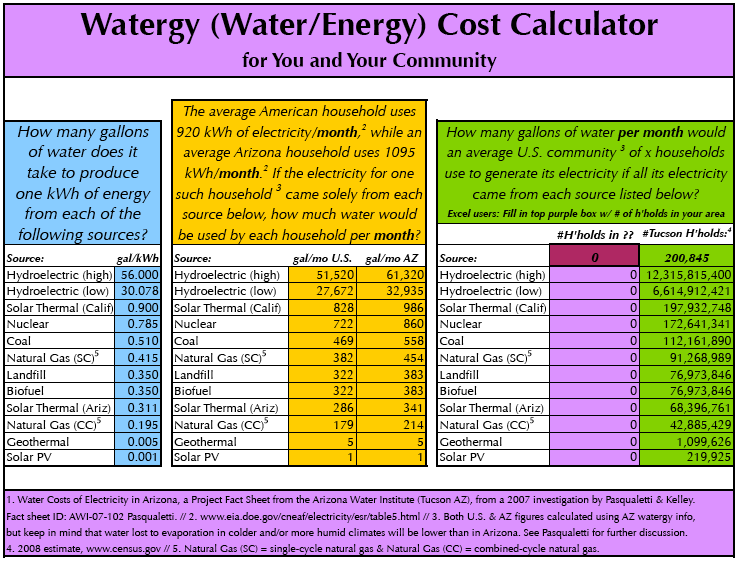
The Watergy Cost Calculator. Notice how a Tucson, Arizona, household consumes 558 gallons of water per month via its electricity consumption if it gets its power from coal (the primary source of electricity in Tucson), but consumes only 1 gallon of water per month via its electricity consumption if it gets its power from rooftop solar. Now let’s go up in scale. Notice how all Tucson households combined consume 112,161,890 gallons of water per month via their combined electrical consumption if they get their power from coal, but they would consume only 219,925 gallons of water per month via their combined electrical consumption if they were to get their power from rooftop solar. Click the image above to visit our interactive online Watergy Calculator, where you can enter the number of households in your community to generate ballpark numbers for how much water your community consumes through its power generation.

The Community Watergy Calculator was conceived of by me, and created by Megan Hartman, based mainly on watergy data for Arizona from this wonderful and succinct resource “The Water Costs of Electricity in Arizona.”

Still more watergy information can be found at www.harvestingrainwater.com/watergy-climate.

Before I speak or teach in various communities, Megan generates one-page Water Conservation and Climate Data sheets (newer versions contain additional information for site analysis and are called Patterns of Climate, Water Per Capita, Watergy, and Sun) for those communities. Many of these are available here, with more being added on a regular basis. These spreadsheets also list:

• What percentage of the community’s energy consumption is used to move (or move and treat water), or the number of average energy-consuming homes that could be powered with the energy used to pump/treat water, depending on the data we are able to obtain.

• How much rain per person per day falls on the community in a typical year (rainfall GPCD) compared to how many gallons of municipal water per person per day are consumed in a typical year (municipal GPCD). In most cases, per year, a greater volume of rain falls on the community than is provided by the municipality. This helps make the case that if the community were to harvest and utilize more of that free, high-quality rainwater, it could reduce or eliminate its depletion of local water sources, and reduce or eliminate the “need” for the high cost/high energy importation of water from elsewhere.

Patterns of Climate, Water Per Capita, Watergy and Sun for Tucson, AZ. Notice how the average Tucsonan uses 112 gallons of municipal water per day. And notice how during an average year there are 198 gallons of rain available per person per day – if only we were to harvest that rain and make it available throughout the year. To arrive at this rainfall GPCD figure, the spreadsheet calculates how much rain falls on the surface area of Tucson in a year of average rainfall, then divides that figure by 365 (days per year), and then divides the result by the population of Tucson. Also notice that 44% of the City of Tucson’s annual municipal energy consumption is used to move and treat water.

For simple and effective tips on how you can greatly reduce your energy consumption at home; increase your on-site passive heating, cooling, and solar power production; and enhance comfort and productivity, see Chapter 4 of Rainwater Harvesting for Drylands and Beyond, Volume 1. The whole book is packed with great info on how you can make progress on goals like these, while greatly enhancing the potential and use of your local rainfall, stormwater, greywater, and more.


1. Extrapolated from Water Costs of Electricity in Arizona, a Project Fact Sheet of the Arizona Water Institute (Tucson, Arizona) from a 2007 investigation by Pasqualetti & Kelley. Fact Sheet ID: AWI-07-102 Pasqualetti.

Brad Lancaster: Water Harvesting Presentation – San Diego (CA) Horticultural Society

May 10, 2010
7:00 pmto8:30 pm

Date: May 10, 2010

Time: 7 – 8:30 pm (doors at 6 pm)

Annual Special Evening Event

Brad Lancaster, Speaker, Author, and Leader in the Water Harvesting Movement

Water Harvesting: Turning Drains into Sponges and Water Scarcity into Water Abundance

The San Diego Horticultural Society presents its annual Special Evening, this year featuring Brad Lancaster, a highly-respected leader in the water harvesting movement. In his inspiring PowerPoint presentation, Lancaster shares eight universal principles of water harvesting along with simple strategies that turn water scarcity into water abundance. These principles empower you to create integrated water-sustainable landscape plans at home and throughout your community. You’ll be inspired—and empowered— to start harvesting this precious resource for your own garden.

Rainwater harvesting is the process of capturing rain and making the most of it as close as possible to where it falls. Greywater harvesting is the process of directing water from household sink, bathtub, shower, and washing machine drains into the soils of the landscape where the water is naturally filtered and reused to generate more on-site resources. The two work hand in hand, and can reduce our water consumption by 30 to 50%! You’ll see examples enhancing local food security, passively cooling cities in summer, reducing costs of living and energy consumption, controlling erosion, averting flooding, reviving dead waterways, minimizing water pollution, building community, creating celebration, and more.

The presentation starts at 7 p.m. (doors open 6 p.m.) at the Surfside Race Place, Del Mar Fairgrounds at 2260 Jimmy Durante Blvd in Del Mar. Parking is free and everyone is welcome.

Tickets for this exciting Special Evening are $15/SDHS members, $25/non-members. Come anytime after 6 p.m. to shop for plants and garden-related products, and to purchase the speaker’s two books. Seating is limited, and tickets may be ordered on-line at www.sdhortsoc.org

Drops in a Bucket Blog

 »Read all blog posts...

Upcoming Events

Also see the full list of upcoming events.