Events for July, 2010
by Brad Lancaster, www.HarvestingRainwater.com, © 2010
Number 3 in a series of Drops in a Bucket blog entries on Brad Lancaster’s and David Eisenberg’s U.S. State Department-sponsored adventures and gleanings in the Middle East
Al Absaa, Saudi Arabia, April 2009
At Al Absaa we toured irrigation projects within the largest oasis in Saudi Arabia. Over one million date palms grow here. But the springs that have fed the oasis for generations are going dry. Oil drilling by Aramco has diverted, blocked, or consumed water flows that used to feed the oasis. The city of 1.5 million is also rapidly growing and consuming additional water. This is a story I encounter again and again the world over; this time it just happens to be in Saudi Arabia.
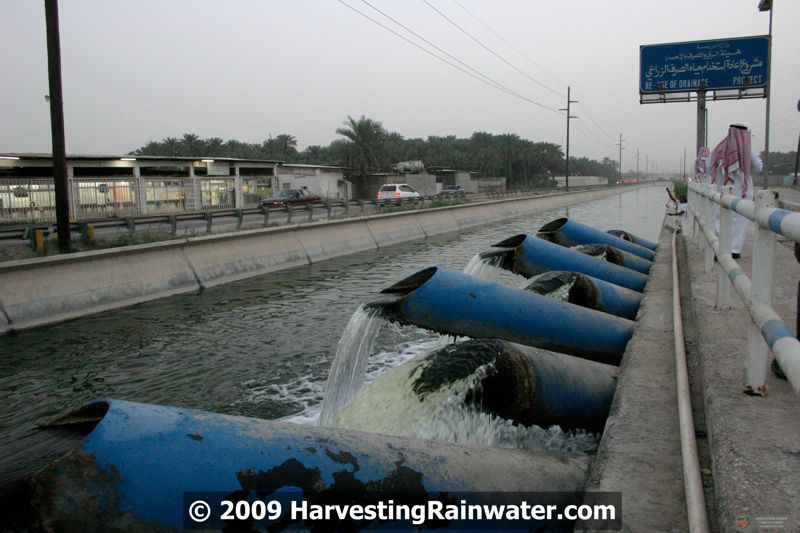
To keep the oasis and the agriculture watered, 75,000 cubic meters of treated sewage per day are directed to the fields. There are 1,500 kilometers of irrigation canals. Every year, 45 kilometers of these canals are converted to sealed or covered canals. Farmers that flood-irrigate get 3 Saudi riyals (one SR equals about US$0.27) per kilogram of their dates. Those that use drip irrigation get 5 SR/kg. Eighty million riyals is being spent to purify irrigation drainage and sewage, which is then blended with spring water from 32 natural springs before being directed into the irrigation system. The sewage from a city 140 km away will also be directed to the oasis by 2010. Nonetheless, the water table continues to drop.
 Recycled water directed into the irrigation canals
 Pumps used to move the recycled water through the irrigation system
One spring, “The Mother of Seven (Streams),” is now the mother of none. Twenty years ago it stopped flowing on its own. Water must now be pumped. We looked down into the deep hole from which the spring water used to flow. The hole was dripping, but empty.
 The pump house and grate over the spring
 The spring
 Our hosts and guides
 Speaking to the father and son mentioned above. Photo by David Eisenberg.
A father and son were swimming in a pool fed by the spring’s pumps. The father told me that the water used to be warmer, that he always swam here as a boy, and was glad his son could do likewise. I wondered if there would be water here for his grandson to swim in.
The oil drilling, along with the rapid growth and consumption made possible by cheap oil, are killing the oasis. In a way, for the short-term, the cheap oil is also extending the life of the oasis by powering pumping and treatment. But this life extension is completely oil-dependent, and there are many problems with pollution caused by the oil consumption. The oasis thrived for hundreds of years requiring no pumps, no power. The water was readily accessible. When the oil runs out, it may be that no one will be able to access the water because there will be no power to run the pumps. Though if the excessive pumping stops, maybe, very slowly, the ground water will eventually rise again.
While, the Saudi efforts to save or at least extend the life of the oasis are very impressive, I couldn’t help but think that more resources should be invested in restoring (and preventing further destruction of) the natural system, rather than just the mechanical.
 Palm frond fence. Others in the area were made only of palm fronds – a great reuse of locally abundant materials.
After touring the irrigation system, our enthusiastic, ever-gracious guide Ibrahim lead us to one of the many highlights of the trip – Red Bread or Hasawi bread.
On the front porch of an old roadside shop sat the rotund baker. When we arrived he went to work slapping 12-inch-wide flatbreads up against the inside of a wood-fired oven shaped like an olla. The bread stuck to the side of the oven and when removed was absolutely delicious. It was spiced with dates and fennel — I was in heaven. Not just because of the incredible food, but because this place was old and felt rooted and real. The dates were from just outside the shop. No new, modern glitz. Just great local food. I dreamed that if I were living here, I’d be a daily regular and maybe even an apprentice.
 Red bread ready to eat
 Red bread being made
See the books Rainwater Harvesting for Drylands and Beyond for strategies that help restore natural water systems. And see the Drops in the Bucket Blog at www.HarvestingRainwater.com for more dispatches from the Middle East and beyond.
Posted in Drops in a Bucket Blog | 1 Comment »
| August 26, 2010 | | 6:30 pm | to | 8:00 pm |
Join hosts Technicians for Sustainability (tfssolar.com) on August 26, 2010, at 6:30pm for a captivating 1-hour talk, “Water Wanderings and More in the Middle East,” with Brad Lancaster, author of the award-winning Rainwater Harvesting for Drylands and Beyond.
In this presentation, Brad will share inspiring stories and images gleaned during two recent trips to the Middle East: a U.S. State Department-sponsored trip to Jordan and Saudi Arabia in 2009, and a return trip to the region in 2010 to teach permaculture in Palestine and conduct research in Syria and Israel.
Topics Include: sustainable groundwater extraction with ancient gravity-fed qanats; the forgotten and refound cisterns of old Jeddah; revived Nabatean runoff farms producing almonds, carob, olives, pomegranates, grapes, figs, and more on just 4 inches (50 mm) of rain per year; rainwater tea; revolving community loan funds; water wise women of Jordan; tank culture in a water-truck culture, the spiral cisterns of the Bell Caves, salvaged plastic bottle irrigation, and kanafa.
Where: TFS’s downtown location at 612 N 7th Avenue. Car parking available on the north side of 5th Street. Plenty of bike parking available.
Reserve Encouraged: Please RSVP by August 19th. Light Middle Eastern refreshments will be served. To reserve your spot, please email TFS community outreach coordinator Aimee King at aimee@tfssolar.com or call 740-0736.
If you are inspired to help spread the word about this event, you can download TFS’ Water Wanderings Talk Flyer and email it around or print and hang on your favorite community bulletin board. Thanks!
Posted in Events | No Comments »
| July 31, 2010 | | 7:00 am | to | 12:00 pm |
During this free workshop you will learn how to implement water-harvesting earthworks with Brad Lancaster on one of his sites here in Tucson.
There will be no lecture and no slide show — all instruction will happen as you work.
This is aptly described as a WORKshop — please attend only if you can come prepared to wield a shovel and give your sweat glands a good workout. In return, you will learn the art & science of earthworks from Brad himself.
Refreshments and refills of your own water bottle will be provided.
Be prepared to be outdoors in the sun for the duration of the workshop. Wear a hat and closed-toe shoes.
Brad will provide some tools, but if you have a shovel, pick, or iron rake you could bring, please do so.
Limited to 20 people.
For location and directions, send an email to admin@harvestingrainwater.com.
Posted in Events | No Comments »
or If You Pray for Rain – Harvest It
By Brad Lancaster, www.HarvestingRainwater.com, ©2010
Number 2 in a series of Drops in a Bucket blog entries on Brad Lancaster’s and David Eisenberg’s U.S. State Department-sponsored adventures and gleanings in the Middle East
Jeddah, Saudi Arabia, April 2009
Most of the water people now drink in Saudi Arabia is desalinated seawater. And there are great costs, among them air pollution from the power plants which burn oil to run the desalination plants. We read articles daily on the many people falling ill from the pollution.
 Air pollution from Jeddah power plant that powers desalination plant. Courtesy of David Eisenberg.
The new Saudi Arabia is very dependent on this oil, not only for water, but for the mechanical heating and cooling of the new modern buildings of imported concrete, steel, and glass.
 New stand-alone modern high-rise and its conceptual “courtyard” (vertical space in the glass wall) referencing the functional traditional courtyards where people gathered in a passively protected microclimate
 Traditional old-Jeddah courtyard created by the shelter of clustered buildings
But the traditional dynamic Saudi culture was borne from surviving and thriving in this hot, dry climate — without oil, imported building materials, or appliances. We wanted to see the old practices of harvesting water, building with local materials, and passive cooling and heating. So, we headed for old Jeddah.
Old Jeddah, Saudi Arabia, is a gem, and as our guide Sami promised, it is replete with a rich tradition of harvesting rainwater, life, and vernacular architecture. Sami Nawwar was our lively host. He is caretaker of the grand Nasseif House/Al Balad at the core of old Jeddah. Sami is hugely excited about old Jeddah and has been fighting to save it for over 40 years. (Throughout our travels we saw the rapid demolition of the old, earthen or coral, passively cooled, pre-oil sections of cities and towns to make way for imported-resource-dependent modern buildings.)
 Nasseif House/Al Balad in old Jeddah, Saudi Arabia
Into the Nasseif House we went. The ceilings are very tall to gain the benefits of passive cooling. Ample shaded windows catch cooling sea breezes. And the walls are made of coral brick interlaced with wooden bond beams, of sorts, every five courses or so to make the building safer in earthquakes. The staircase was built very wide with short steps so horses could easily climb to the top.
 Sami, our gracious host. See brown wooden bond beams in the wall behind him. They help stabilize the coral brick walls in earthquakes.
 Coral brick
Then evening prayer began and Sami shouted, “Quick, to the top! You must hear the prayers from the roof!” From every direction came the call to prayer, rising and falling like the chaotic roof lines around us. Amazing. As the sun set and darkness fell over the city we had tea on the roof, the cooling breeze refreshing us.
In the heyday of Nasseif House/Al Balad, children would sweep off the roof before the rains, and the rainfall would be directed to downspouts taking the water to the huge basement cistern. All non-human waste was composted or fed to livestock. Human waste went into a septic tank that was cleared once a year, then washed with salt. (I did not find out where the human waste went after being cleared from the septic tank.) [Entry continues below.]
 Skyline view #1 from rooftop
 Skyline view #2 from rooftop
 Skyline view #3 from rooftop
 Looking down into the neighborhood from rooftop
 Looking out into Jeddah from rooftop
 Tea on rooftop
 Distant gas flame seen from rooftop
 Cistern is below the floor. Note cistern hatch.
 Cistern hatch and cistern below
BREAK]
“We’re late, we’ve got to go!” our U.S. State Department chaperones informed us. But Sami had promised he’d take me inside a neighboring cistern. I shot him a look. “Follow me,” he said, and we ran past the group. We rushed out of the building, down the street, and along the old mosque.
 Mosque and stores
 Dress shop we entered on left
Turning sharply we entered a modern women’s clothing shop, and sped to the back. Sami stopped in front of a dress hanging on a wall and said, “We are here.”
 The secret cistern entrance
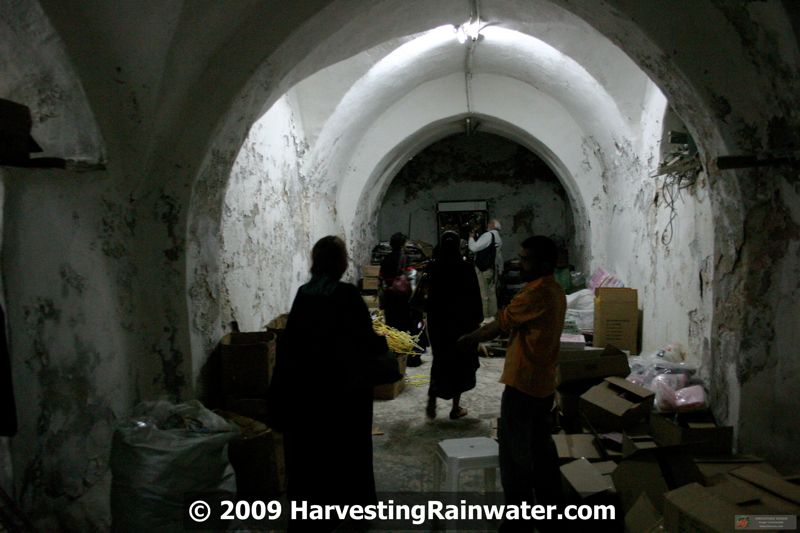
He then pushed the dress aside, revealing a hidden door. We stepped down into a massive cistern with vaulted ceilings. It was the cistern for the mosque. I was having so much fun. We had entered a hidden world, feeling something like the half floor in the movie Being John Malkovich. It was also further confirmation that every culture with a dry season has a tradition of water harvesting, and Jeddah was no exception. With just over 2 inches (50 mm) of rain a year it was not only possible, but absolutely necessary. [Entry continues below.]
 Just a small part of the vast cistern (now used for the storage of clothes) below the mosque
 Cistern inlet and outlet in cistern ceiling. Not currently in use.
These cisterns are seldom used today, what with the temporary abundance of plumbed and pumped distilled seawater, but I feel they are a major part of the solution for the past, today, and the future. These cisterns were the water source of the past. And they could be the, or at least a considerable, water source of today and tomorrow. They work on gravity, not pumps. They do not require pipes throughout the city, only pipes from every roof to a tank below. Beneficial redundancy and resiliency. They also reduce flooding.
Jeddah gets little rain, but most of it comes all at once in big downpours. After our visit floods did major damage in Jeddah. Sprawling construction of new buildings and roads is occurring all over, paving ever more of the watershed. Unfortunately the runoff from this new infrastructure (and the old) is now directed to streets rather than tanks. Thus these floods are more human-created than weather-created.
There is a rich history of praying for rain in this dry country, but the management of that rain has been largely forgotten with the temporarily available “cheap” oil and desalinated water. Much of the answer to those prayers lurks under floors and behind dresses, waiting to be remembered.
See Rainwater Harvesting for Drylands and Beyond, Volume 1, for more on this topic. And click here for information about the Arabic edition of Volume 1, released in Spring 2011.
Posted in Drops in a Bucket Blog | 4 Comments »
or If You—and Your Drink—Sweat, Then Harvest Condensate
By Brad Lancaster, www.HarvestingRainwater.com, ©2010
I am finally getting to the sharing of my travel gleanings. This is the first of a series to follow – so keep checking back. This piece is from my U.S. State Department-sponsored trip to Jordan and Saudi Arabia in 2009. David Eisenberg of DCAT and I were sent as part of an Earth Day-themed cross-cultural exchange. David spoke about green building. I spoke about water harvesting. The trip was incredible, perhaps most of all due to the face-to-face interactions with Jordanians and Saudis – all of whom were incredibly welcoming, gracious hosts. This breed friendships and sharing, rather than the fear generated by the aggression of politicians and nations and misinformation in the media. My heartfelt thanks to all our Jordanian, Saudi, and State-Department hosts.
April 2009
Jeddah, Saudi Arabia, receives only about 2 inches (50 mm) of rain a year. Being that dry, it was odd that water was flowing down the streets and mosquitoes were fierce.
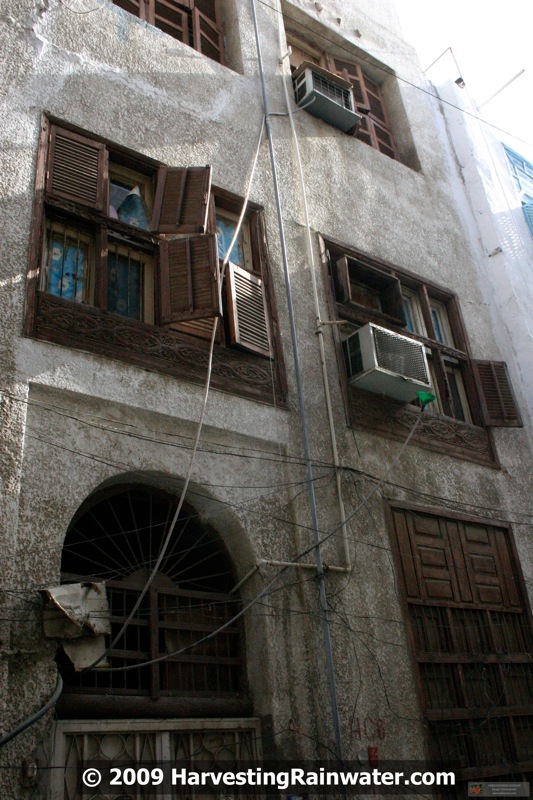
In this hot and humid coastal desert climate, air conditioners abound and their condensate steadily and wastefully drips into the street, pooling where mosquito populations then mushroom. But on occasion you see a wild matrix of funnels and hoses directing that condensate from coolers to courtyard plantings. Here where rainfall is low, but humidity intense, the potential for condensate and dew harvesting is very high.
 Bucket and condensate creek, Jeddah, Saudi Arabia
 Hoses directing air-conditioner condensate to courtyard plantings, Jeddah, Saudi Arabia
How much condensate can you harvest?
IN A DRY CLIMATE/SEASON:
• A home air conditioner can generate 0.25 gallons (1 liter) of condensate/day
• A large commercial air conditioner can generate 500 gallons (1,900 liters)/day
IN A HUMID CLIMATE/SEASON:
• A home air conditioner can generate 18 gallons (68 liters) of condensate/day
• A large commercial air conditioner can generate 2,000 gallons (7,500 liters)/day
In the humid climate of Austin, Texas (USA), the condensate from the City Hall air conditioners provides all the water needed for a large waterfall at the City Hall entrance.
 Top of the Austin City Hall air-conditioner-condensate waterfall
 Bottom of the Austin City Hall air-conditioner-condensate waterfall
Where does your condensate go? If to the sewer drain, redirect it to water-harvesting earthworks and their associated plantings.
Condensate is distilled water. It does not contain salt. Thus it is a high-quality water source. Though there is the possibility of the condensate leaching lead from lead-based solder, if this is used in the cooler’s plumbing, or copper from copper pipes. Air-conditioner manufacturers take note: you can make a cooler without these toxic materials, and then market your appliance as both an air conditioner and a water machine.
Can you harvest condensate in your area? If you have condensate then the answer is yes.
The signs are clear when that harvest is potentially abundant – you sweat like mad and so does your cool drink (condensate beading profusely on your glass).
See Rainwater Harvesting for Drylands and Beyond, Volume 2: Water-Harvesting Earthworks for more on this, including a table helping you estimate your condensate volume.
Posted in Drops in a Bucket Blog | 1 Comment »
| November 10, 2010 | to | November 12, 2010 |
“The Carbon Ranch: Using Food and Stewardship to Build Soil and Fight Climate Change.”
Climate change is the most pressing issue confronting humanity. It is also a tremendous opportunity. Right now, the only possibility of large-scale removal of greenhouse gases from the atmosphere is through plant photosynthesis and other land-based carbon sequestration activities. Strategies include: enriching soil carbon, farming with perennials, employing climate-friendly livestock practices, conserving natural habitat, restoring degraded watersheds and range lands, and producing local food. Over the past decade, many of these strategies have been demonstrated to be both practical and profitable. A carbon ranch bundles them into an economic whole with the aim of creating climate-friendly landscapes that are both healthy ecologically and the source of healthy food.
Confirmed Speakers:
- Dr. David Montgomery, geologist and author of Dirt!: The Erosion of Civilizations
- Sara Scheer, Ecoagriculture Partners
- Dr. Christine Jones, Founder of the Australian Soil Carbon Accreditation Scheme
- Dr. Jeffrey Creque, agroecologist with the Marin Carbon Project
- John Wick, rancher and leader of the Marin Carbon Project
- Greg Judy, rancher and ‘mob-grazing’ educator
- Jeff Moyer, Farm Director for the Rodale Institute, on organic no-till
- Constance Neely, consultant for land, livelihoods and climate change
- Dr. Bill Chameides, Dean of the Nicholas School of the Environment, Duke University
- Abe Collins, New Soil Matrix
- Brock Dolman, Director of the Occidental Arts & Ecology Center
- Nancy Ranney, rancher, Ranney Grassfed Beef
- Steve Apfelbaum, Applied Ecological Services
For general information on the conference, visit:
quiviracoalition.org/_2010_Conference/index.html
To download the conference announcement (3-page PDF), click here:
Quivira 2010 Conference Announcement
To register (or for registration details, including cost):
quiviracoalition.org/_2010_Conference/Online_Registration/index.html
To contact the Quivira Coalition:
The Quivira Coalition
1413 Second Street, Suite 1
Santa Fe, NM 87505
(505) 820-2544 ext 0#
admin@quiviracoalition.org
The mission of The Quivira Coalition is “to build resilience by fostering ecological, economic and social health on western landscapes through education, innovation, collaboration, and progressive public and private land stewardship.”
Posted in Events | No Comments »
| July 17, 2010 | | 1:30 pm | to | 3:30 pm |
WMG Water Harvesting Lecture Series #5: Water Harvesting for Food Production
Internationally renowned water-harvesting expert Brad Lancaster will offer a presentation on the use of water-harvesting systems for food production. Food is virtual water – originating from the source of irrigation. Local, sustainable food is all the rage, but we can take it further by growing that food with local, sustainable water. This talk covers the growing of food using rainwater, stormwater, and greywater for irrigation. Case studies include rain-fed greenhouses, dryfarming, backyard market gardens, granada greywater groves, and climate-appropriate traditional and appropriate plantings. This class is a session of Watershed Management Group’s Water Harvesting Certification program that is made available to the public.
Cost: $25
Date & Time: Saturday, July 17, 1:30 – 3:30pm
**Updated Location: Ward 3 City Council Office: 1510 E Grant Rd
Space is limited; register with James MacAdam, james@watershedmg.org, 520-396-3266.
Visit watershedmg.org for more information.
Posted in Events | No Comments »
| July 15, 2010 | | 2:30 pm | to | 4:30 pm |
WMG Water Harvesting Lecture Series #4: Landscape Design for Water Harvesting
Landscape designer and author Scott Calhoun will present on the application of landscape-design principles to water-harvesting landscapes. This class is based on the premise that water-conserving landscapes can be detailed, beautiful, and plant-rich. Participants will learn about the distinctive qualities of desert gardens and be introduced to basic landscape design skills. We will discuss how patios, rocks, and plants are incorporated into gardens as design elements. This class is a session of the WMG Water Harvesting Certification program that is made available to the public.
Cost: $25
Date & Time: Thursday, July 15, 2:30 – 4:30 pm
Location: WMG Office, 3809 E 3rd St, Tucson
Space is limited; RSVP to James MacAdam required, james@watershedmg.org, 520-396-3266.
Visit watershedmg.org for more information on the course.
For more information on Scott Calhoun, visit zonagardens.com.
Posted in Events | No Comments »
| July 12, 2010 | | 1:30 pm | to | 3:30 pm |
WMG Water Harvesting Lecture Series #3: Water Harvesting Earthworks
WMG co-founder, instructor and water-harvesting expert Catlow Shipek will offer a presentation on the types and uses of water-harvesting earthworks. The presentation will include information on design, installation and best practices for the use of earthworks for harvesting rainwater and reducing erosion. This class is a session of the WMG Water Harvesting Certification program that is made available to the public.
Cost: $25
Date & Time: Monday, July 12, 1:30 – 3:30pm
Location: WMG Office, 3809 E 3rd St, Tucson
Space is limited; register with James MacAdam, james@watershedmg.org, 520-396-3266.
Visit watershedmg.org for more information.
Posted in Events | No Comments »
| July 11, 2010 | | 1:30 pm | to | 3:30 pm |
WMG Water Harvesting Lecture Series #2: Greywater
Internationally renowned water-harvesting expert Brad Lancaster will offer a presentation on the use of greywater as a water resource. This talk covers all the basics of gravity-fed greywater harvesting systems – ranging from very simple-to-install systems such as the “Bucket & Chuck It,” to more complex-to-install, but much more convenient-to-use Branched-Drain and Multi-Pipe Laundry systems. Retrofits and new construction are covered, along with greywater-harvesting stubouts, guidelines, laws, appropriate soaps and detergents, maintenance, case studies, and kitchen sink dark greywater systems. This class is a session of the WMG Water Harvesting Certification program that is made available to the public.
Cost: $25
Date & Time: Sunday, July 11, 1:30 – 3:30 pm
Location: 940 W Alameda Ave, Tucson
Space is limited; register with James MacAdam, james@watershedmg.org, 520-396-3266.
Visit watershedmg.org for more information.
Posted in Events | No Comments »
|
- 25 July:
- 8 September:
- 10 September:
- 17 September:
Also see the full list of upcoming events.
|